


There are corners of Britain where older patterns remain. A narrow lane turns between raised banks, and on either side stands a living boundary of hawthorn, blackthorn, hazel and field maple. In spring it whitens with blossom. By autumn it carries berries and sloes.
In winter it meets the wind without complaint. This is the hedgerow. It marks land, certainly, but it does far more than that.
For centuries, hedgerows helped shape the countryside. They enclosed fields, sheltered livestock and gave farms a natural framework. Over time they also became habitat. Birds nested in their branches. Insects fed on their flowers. Small mammals moved along their bases under cover.
What once served practical needs now serves ecological ones too.
That matters because Britain has lost a great many hedgerows. After the Second World War, many were removed to create larger fields or make room for roads and development. The result was not only a change in appearance. Wildlife routes were broken, and many species found themselves cut off from feeding and breeding areas.
Where hedgerows remain in good condition, life quickly gathers. European Hedgehog often uses rough margins and connected cover. Hazel Dormouse benefits from linked networks of scrub, woodland edge and hedgerow in parts of southern Britain. Songbirds such as robins, wrens and yellowhammers nest within dense growth. Bats regularly follow hedgerows at dusk, using them as sheltered flight lines between roosts and feeding ground.
They help the wider landscape as well. Roots hold soil together during heavy rain. Hedges slow wind across open farmland. Leaves and woody growth store carbon over time. In some places,a healthy network of hedges can also help water soak into the ground rather than racing straight into streams.
There is another role that receives less attention: hedgerows may help keep elm alive in the British landscape.
The English Elm and related native elms were once familiar trees across much of lowland Britain. Dutch elm disease then caused devastating losses from the late twentieth century
onwards.
The disease is spread mainly by elm bark beetles, which tend to favour larger mature trees for breeding. Yet young elm regrowth often survives in hedgerows, sending up suckers from established root systems. Because these stems are smaller and are often cut back as part of hedge management, they can be less suitable for the beetles that spread the disease.
That does not remove the threat, though it can allow elm to persist where mature trees have gone. It is a modest kind of survival, but an important one. Hedgerow elms keep the species present in the countryside and may support future planting of disease-resistant stock.
Across Britain, many farmers, landowners and community groups are restoring hedgerows.
Gaps are being replanted with native species. Old hedges are being laid or coppiced to thicken growth from the base. New agri-environment schemes have also encouraged better management in some areas.
Done properly, this work improves habitat while strengthening the
farmed landscape itself. As naturalist John Wright once wrote, “A hedge is a wood in miniature.” It is hard to put it better.
Britain often looks for answers in large projects and distant plans. Sometimes the useful answer is already close at hand, running beside a field or tracing an old lane. Restore a hedgerow, and the gains begin quietly. Wildlife returns. Soil stays put. Young elms endure. The land becomes a little richer than it was before.
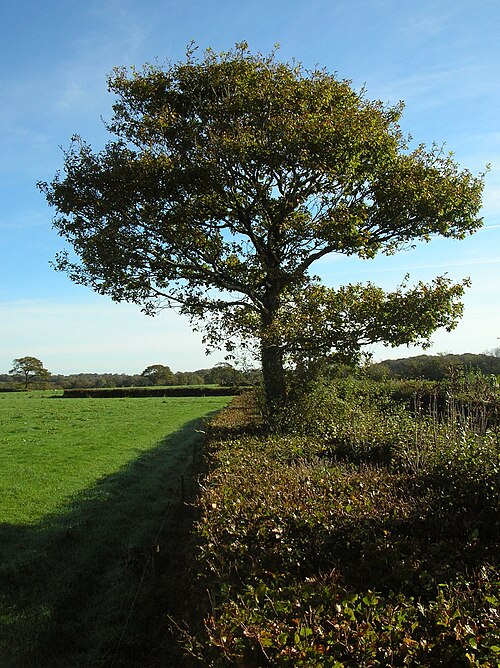
Oak and Beech hedgerow.
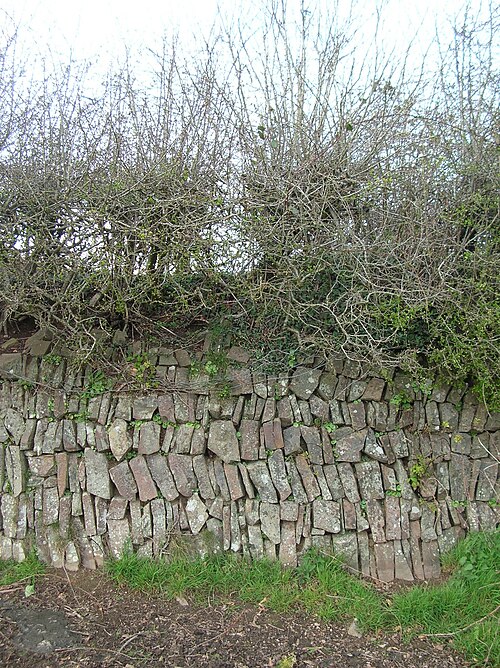
A traditional stone-faced Devon hedge.
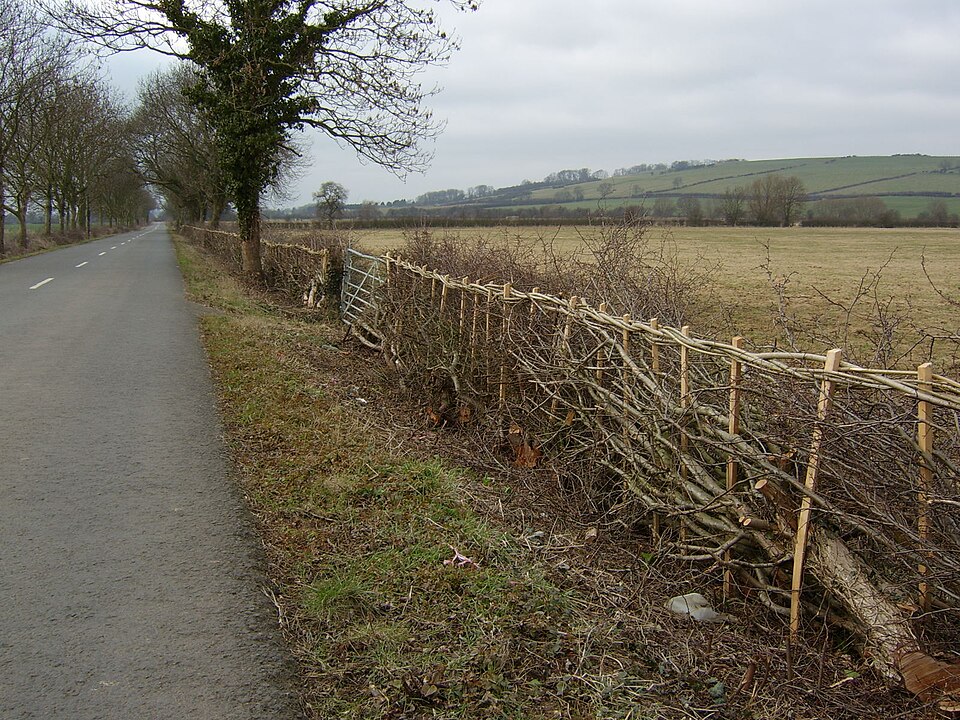
Newly laid hedge. Northamptonshire