


It gathers in gutters, slips into drains, hurries beneath streets, and emerges in rivers and estuaries. If you stand near an outfall after rain, you can sometimes smell the world upstream before you see it. Most of it is ordinary, forgettable. Yet some of what we pour into the earth lingers, settles into mud and sediment, threads itself into food webs and into the quiet margins of living, and it stays there long after.
That is the shadow that hangs behind a new announcement from the British government. On 3rd February 2026, Defra published what it calls the country’s first plan to tackle per- and polyfluoroalkyl substances (PFAS), the group of chemicals often nicknamed “forever chemicals” because of their persistence in the environment.
PFAS are not a single substance but a family, extremely effective and used for decades. They repel water and grease, resist heat, and hold up under wear and stress. They were introduced into critical manufacturing and into low carbon technologies, but also into the everyday world from water-repellent clothing to certain production methods for consumer goods. The government’s press release describes PFAS as “one of the most pressing environmental challenges of our time,” and warns that the risks “will likely remain for hundreds of years.”
The framework to tackle the issue aims to coordinate action across government, regulators and industry. It is not a single ban or a single fix. It is, instead, a promise to map sources, understand pathways, and reduce exposure. In a world where environmental harm often slips between departments and responsibilities, the insistence on coordination matters, because PFAS do not respect administrative borders any more than rivers do.
Two parts of the announcement stand out.
First, the government says it will consult later this year on introducing a statutory limit for PFAS in England’s public water supply regulations. It states there is currently “no evidence of PFAS above permitted levels in England and Wales,” but the consultation is framed as a protective move, and as a tool that would make it easier for regulators to enforce if permitted levels were ever exceeded.
Second, it commits to assessing “the full extent of ‘forever chemicals’ in England’s estuaries and coastal waters” for the first time, with improved testing and monitoring that includes sediment and invertebrates. Estuaries are not just pretty boundaries between river and sea. They are nurseries, filters, feeding grounds, and corridors. If PFAS are present, those are the places where they will often reveal their long-term effects, not occasional spikes, but as a steady, stubborn trace.
Environment Minister Emma Hardy said: “The persistent nature of ‘forever chemicals’ means they pose a long-term challenge for not only our health, but that of the nation’s vital ecosystems.” She added that the government would “act decisively to reduce their harmful effects while transitioning to safer alternatives.”
Environment Agency chief executive Philip Duffy said: “Through our monitoring programmes, risk screening work, regulatory expertise and assessment of evidence, we are helping to inform the public and stakeholders about our work to protect the environment from the risks posed by PFAS.”
For many years, PFAS have sat in that uneasy category of modern problems that are technically complicated, widely dispersed, and easy to ignore precisely because they do not always present as a single dramatic event. They arrive as contamination in soil, as residues in water, as the slow accumulation of substances designed not to break down. When governments finally speak plainly about them, it is often because the evidence has become too heavy to keep hidden.
A plan is not the same thing as enforcement. A consultation is not the same thing as a limit with teeth. And the transition to safer alternatives will test how serious we are about the quiet trade-offs we have been making for decades: convenience, performance, cost, all bought with materials that the natural world cannot easily put back into the cycle. A plan is fine. The question is whether it bites.
Still, there is something quietly encouraging in the fact that this is being named as a national environmental challenge, not a niche chemical story. Britain has learned, repeatedly, that what reaches our coasts and rivers eventually reaches our lives. If PFAS really are to become not a forever problem, then this framework has to turn into monitoring that finds the truth, regulation that holds, and practical change in what we produce, use, and discard.
The water always carries the story onward.
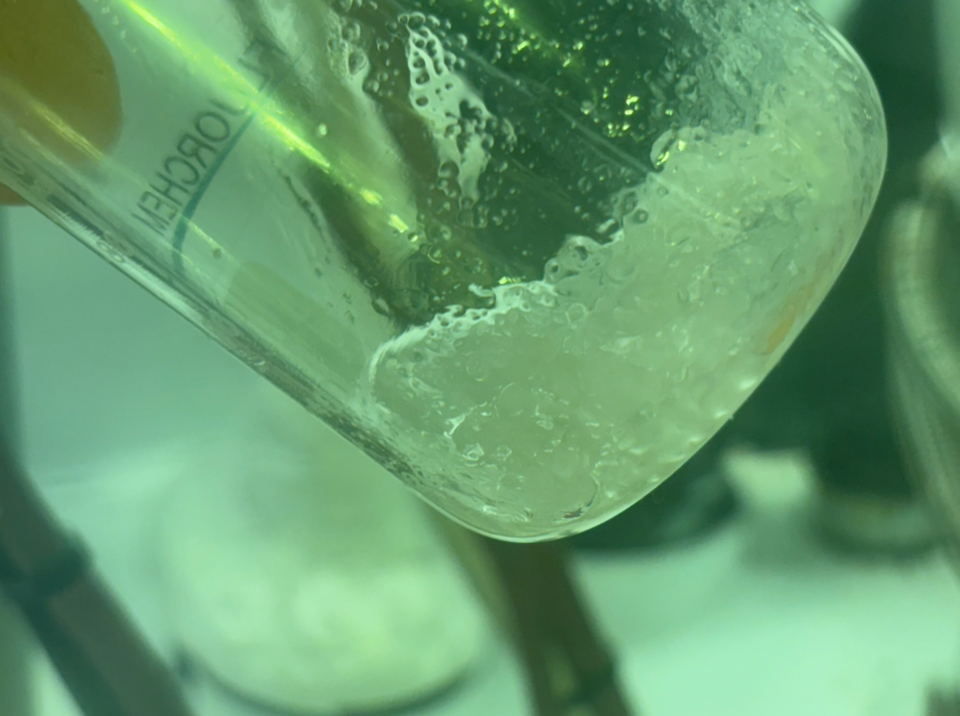
PFAS residue