


On Floreana Island in the Galápagos, a creature long thought lost to history now walks again across volcanic earth and sun-bleached scrub. In late 2025 and early 2026, conservation teams reintroduced juvenile Floreana giant tortoises (Chelonoidis niger niger) to their ancestral home, almost two centuries after the original population was driven to local extinction. The release follows years of genetic research, captive breeding and invasive species removal, and marks one of the most ambitious ecological restoration efforts undertaken anywhere in the archipelago.
By the mid-nineteenth century, whalers and early settlers had stripped Floreana of its tortoises. Large, slow and easily captured, they were taken in great numbers to provision ships crossing the Pacific. Their disappearance was swift; the consequences unfolded more quietly. Giant tortoises are not merely inhabitants of these islands but among their chief architects. Through grazing, trampling and long wandering journeys, they open pathways in dense vegetation and carry seeds across landscapes that might otherwise remain divided. When Chelonoidis niger niger vanished, the island endured, but it endured diminished.
The possibility of return emerged from an unexpected quarter. On Wolf Volcano on Isabela Island, scientists identified tortoises carrying substantial genetic ancestry from the extinct Floreana lineage. These animals, descendants of individuals historically moved between islands, became the foundation of a carefully structured breeding programme at the Charles Darwin Research Station. Beginning in 2017, conservationists selected breeding pairs with the closest genetic match to the original Floreana population. Over successive seasons, hundreds of juveniles were raised under managed conditions.
Preparation for their return required more than patience in a breeding centre. On Floreana itself, invasive predators such as rats and feral cats had to be systematically removed. These species once preyed heavily on eggs and hatchlings, ensuring that any natural recovery was impossible. Only after years of eradication work and habitat management were the first young tortoises transported back and released into designated zones. Each animal is now monitored to track its movements, feeding habits and survival.
The wider significance lies in what these tortoises represent within the ecosystem. Across the Galápagos, giant tortoises function as keystone herbivores. Their grazing maintains open areas that allow sunlight to nourish low-growing plants. Their dung enriches soil and disperses viable seeds across considerable distances. On islands where tortoise populations have been restored, shifts in vegetation structure and regeneration have followed. On Floreana, early observations suggest that native plants are already benefiting from renewed seed dispersal and grazing patterns in areas visited by the juveniles. It is too early to speak of full recovery, yet the first threads of repair are discernible.
For the island’s small resident community, the return carries resonance beyond ecological data. Floreana is not wilderness in abstraction; it is home. The sight of a young Chelonoidis niger niger moving through Scalesia woodland or resting among cactus stands serves as a reminder that restoration is not only about statistics and survival curves. It is about continuity. The Galápagos are often invoked as a cradle of evolutionary insight, yet they are also places where human action has left scars. To witness a species step back into its former role is to glimpse what long-term stewardship can achieve.
There are no illusions that the work is complete. Genetic reconstruction cannot recreate the past in perfect form, and long-term viability will depend on continued monitoring, biosecurity and habitat protection. Climate variability, shaped by shifting ocean currents and periodic extremes, adds uncertainty to every projection. The juveniles released today must survive, mature and reproduce before a self-sustaining population can be declared secure.
Yet in their slow, deliberate progress across Floreana’s dark stone and pale grasses, there is a kind of measured hope. These tortoises do not herald their return with spectacle. They graze. They wander. They endure. In doing so, they begin again the patient labour of shaping the land that once shaped them. On an island that had forgotten their weight, the ground now remembers.
If you would like to hear more about the islands, listen to our podcast episode here:
Restore Our Planet Podcast #75 Fighting Pollution in the Galapagos Islands: Jess Howard
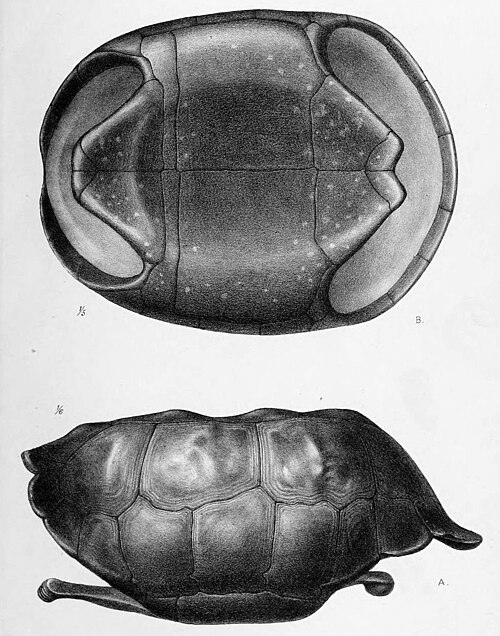
Only known drawing of the extinct Chelonoidis niger niger
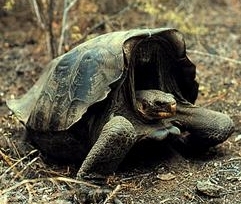
Wolf Volcano Tortoise ( closely related to Floreanas ) with their evolved saddle_backed shells for feeding